Treasure in the Skip: Bury's Artists Turning Rubbish Into Something Remarkable
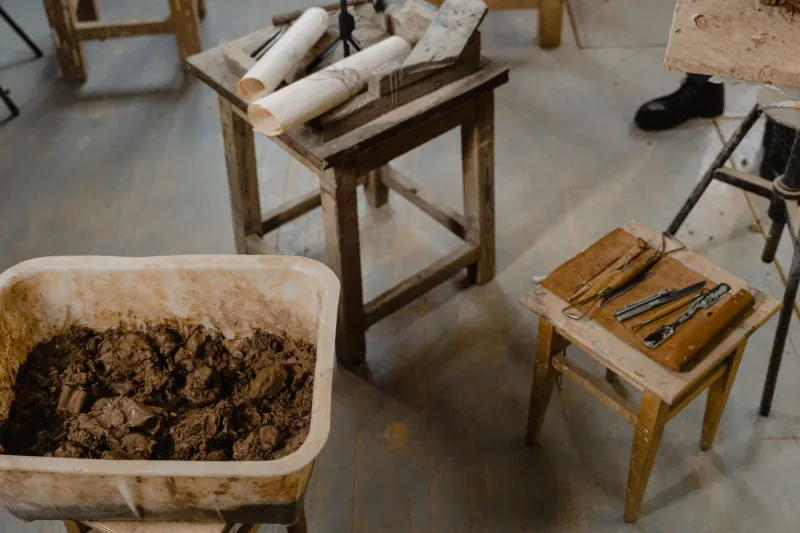
Before we get into the art, let's talk about the materials. A stack of warped floorboards salvaged from a demolished pub off Bury town centre. Three bin bags of fabric offcuts from a clothing manufacturer in Radcliffe. Forty-seven glass jars, assorted sizes, liberated from a restaurant's recycling. A roll of wire mesh that spent six months behind a builder's merchant before someone thought to ask if it was going spare.
This is the raw material of some of the most interesting work being made in Bury right now. And the artists making it wouldn't have it any other way.
A Philosophy, Not Just a Workaround
It would be tempting to frame the use of waste and surplus materials purely as a response to financial pressure. And yes, for many independent makers, the economics are straightforward — free materials are better than expensive ones. But spend any time talking to Bury's makers who work this way and you quickly realise that the relationship with rejected materials goes much deeper than thrift.
"There's something about a material that's already lived," says Donna, a sculptor whose large-scale installations have appeared in several of Bury's public spaces and festival settings. "It's got a history. It's got marks on it. You're not starting from nothing — you're starting from something that already means something, even if you don't know exactly what yet."
Donna's current piece incorporates timber from three different sources: a demolished mill building, a garden clearance, and a skip outside a house renovation on a residential street she walks past every morning. The wood is visibly different in each section — different ages, different treatments, different degrees of weathering. That difference, she argues, is the work. "If I'd bought new timber, I'd have had to invent all of that. The material would have been passive. This stuff is active. It pushes back."
The Fabric Finders
In Bury's textile community — and it's a significant one, given the town's deep manufacturing heritage — the use of surplus and rejected fabric has a long history that predates any contemporary sustainability conversation. Generations of makers here grew up in households where nothing was wasted, where the end of a bolt of cloth became a cushion cover or a patchwork panel or a child's fancy dress costume.
That instinct has been inherited and radicalised by a younger generation of fashion and textile artists who see the mountains of discarded fabric produced by the UK clothing industry not as someone else's problem but as their primary resource.
Sadie, 26, runs a small fashion practice out of a shared studio space near the market. She sources almost all her material from manufacturers' offcuts, charity shop donations, and — her particular speciality — the end-of-season surplus that larger retailers discard rather than discount. "The fashion industry produces an obscene amount of waste," she says, without particular heat. "I'm not going to fix that. But I can intercept some of it and make it into something that lasts."
Her pieces are emphatically not the rough-edged aesthetic that the word 'upcycled' sometimes conjures. They're considered, carefully constructed, and genuinely beautiful — which is, she says, part of the point. "I want people to look at the work and think it's lovely before they know what it's made from. I don't want the materials to be a gimmick. I want them to be invisible until you look closely, and then I want you to look at them differently."
Constraint as Creative Engine
There's a well-established idea in creative practice that constraint is generative — that having fewer options forces more inventive solutions than unlimited resources ever would. Bury's waste-material makers are living proof of this principle, and many of them describe the limitations of working with found materials not as a frustration but as the engine of their most interesting work.
"When you've got a beautiful blank canvas and a full set of paints, the possibilities are so open they can be paralysing," says Marcus, whose sculpture practice we encountered earlier in a different context. He began working with salvaged metal partly out of necessity and has never gone back. "When you've got this weird bent piece of steel and you're trying to work out what it wants to become — that's a much more interesting problem. The material is already asking you a question."
This collaborative relationship with material — the sense of the maker responding to what's already there rather than imposing a predetermined vision — comes up repeatedly in conversations with Bury's waste-material artists. It produces work that has a quality of discovery to it, a sense that the finished piece was found rather than fabricated.
Community Pipelines
One of the most striking aspects of Bury's waste-material creative culture is how organised it's become. What began as individual makers keeping their eyes open for useful skips has evolved into something more deliberate — informal networks through which surplus materials circulate between creators, and relationships with local businesses who now actively think about who might want their offcuts before they arrange collection.
A joinery near Bury Market now keeps a designated shelf of offcuts and miscuts that makers can collect for free. A printing company saves its misprints and paper waste. A ceramics supplier passes on seconds and damaged stock. None of this is formally organised. It runs on goodwill, WhatsApp groups, and the understanding that what's rubbish to one person is raw material to another.
"It's become part of how this community works," says Donna. "We look after each other's practice by keeping an eye out. Someone messages the group: there's a skip on such-and-such street with interesting stuff in it. Twenty minutes later, someone's gone to look. It's completely normal to us now."
The Deeper Story
Bury has always been a town that knew how to make the most of what it had. Its industrial history was built on ingenuity and hard graft, on the ability to work with available resources and produce something of value. The artists working with waste materials today are, in their own way, continuing that tradition — finding worth in what others have overlooked, and making something that endures from what was headed for the tip.
That's not a romantic gloss. It's just the truth of what's happening in studios and shared spaces across this town, quietly and without much fuss, one salvaged piece of timber and one rescued bolt of cloth at a time.