Art Is Not an Extra: The Bury Teachers Quietly Refusing to Let Creativity Die in Their Classrooms
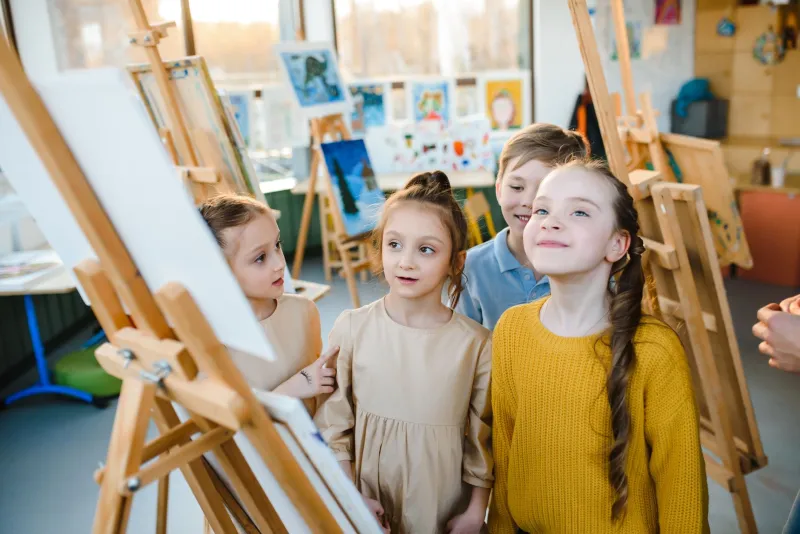
There's a year seven class in a Bury secondary school that has been studying fractions using drum rhythms. A primary school not far away has spent the last term creating a community mural with a local visual artist, embedding history, geography, and personal identity into every painted square. And at another school across town, a group of fifteen-year-olds is writing and performing their own short plays, working alongside a professional theatre company in a partnership that costs the school almost nothing.
None of this is on the official curriculum. All of it is happening anyway.
The Squeeze That Shouldn't Be Happening
Let's be honest about the context. Arts education in English schools has been under sustained pressure for the better part of fifteen years. The introduction of the EBacc performance measure, which excludes arts subjects, sent a clear signal about what the government considers educationally valuable. Schools chasing league table positions responded accordingly. Between 2010 and the early 2020s, the number of pupils taking GCSE arts subjects fell dramatically. Drama, music, and art teachers were cut. Timetable space shrank.
Bury's schools haven't been immune to this. Several have reduced dedicated arts provision. Budgets for visiting artists, theatre trips, and musical instruments have been slashed or eliminated. The pressures are real and ongoing.
But what's also real is the response from teachers who refuse to accept that creativity is a luxury their pupils can't afford.
Finding the Gaps
Mr. Okafor, a music teacher at one of Bury's larger secondaries, started the drum-rhythm fractions project after noticing that a significant number of his Year 7 pupils were struggling with mathematical timing concepts but thriving in music sessions. "It wasn't a grand theory," he says. "I just thought, they understand this in one context — what if we built a bridge?"
The results were striking enough that the maths department got interested. Now the two departments co-deliver a short unit twice a year. Test scores in the relevant topics have improved. More importantly, pupils who had written themselves off as "not maths people" found a way in.
"That's what arts integration does when it's done properly," Mr. Okafor argues. "It doesn't dilute the academic content. It gives more children access to it."
This approach — finding the connective tissue between creative practice and core subjects — is being replicated across Bury's schools in different forms. A primary school has embedded storytelling and illustration into its literacy programme, working with a local author and illustrator who visits regularly. The school can't pay commercial rates, but the partnership works because the artist values the relationship with the community and the school provides a platform for her work.
The Theatre Partnership Model
Perhaps the most ambitious example of what's possible is the ongoing collaboration between a Bury secondary school and a local theatre company that has been running for three years.
The arrangement began simply enough: the theatre company needed rehearsal space and the school had a hall sitting empty three evenings a week. The school needed enrichment activities for pupils who were disengaged from formal academic routes. Both parties had something the other wanted.
What grew from that practical exchange has become something much more significant. Pupils work with professional directors and performers on original short plays, developed over a full term. The work is performed publicly — at the school, and on at least one occasion at a community venue in town. Young people who had never set foot in a theatre are now going to see shows. Some have started volunteering with the company.
"We've had pupils completely transform over the course of a project," says the school's head of drama. "Not just in terms of confidence on stage — though that happens — but in how they see themselves. A kid who's been told implicitly for years that they're not academic, and then they write something and perform it and an audience reacts to it... that changes something."
The Numbers Behind the Stories
Teachers are rightly wary of reducing the value of arts education to measurable outcomes — the argument that creativity only matters if it improves SATs scores is precisely the kind of thinking that got us into this mess. But the data that does exist is worth noting.
Research consistently shows that sustained engagement with arts education improves attendance, reduces exclusion rates, and has measurable positive effects on wellbeing and academic engagement more broadly. Schools in Bury that have maintained or expanded arts provision report anecdotally that these patterns hold locally.
More concretely, several pupils who came through Bury's school-based arts programmes have gone on to further creative education — at drama schools, art colleges, music conservatoires — who might not have considered those routes without the exposure they got in school.
What the Town Owes Its Schools
Bury Festival, as a concept and a community, rests on a particular idea: that this town has a genuine, living cultural identity worth celebrating and protecting. The mural artists, the brass bands, the theatre companies, the spoken word performers, the musicians — they didn't arrive fully formed. They were children once, in classrooms, and somewhere along the way something sparked.
The teachers doing this work are, in a very real sense, the beginning of the pipeline that makes everything else possible. Without the spark in the classroom, there's no artist at the market, no performer on the stage, no maker in the studio.
And yet these teachers are largely doing this on their own initiative, in their own time, with minimal institutional support. They're writing grant applications in the evenings. They're cultivating relationships with local artists and companies because nobody else is doing it for them. They're being creative about creativity, which is both admirable and slightly absurd.
What Would Actually Help
A more joined-up approach between Bury's cultural organisations and its schools would cost relatively little and could make a significant difference. A shared directory of local artists willing to work in schools. A small fund for subsidising visits and partnerships. A network for teachers to share what's working.
None of this requires a government policy change or a major funding injection. It requires the town's cultural community — the venues, the festivals, the arts organisations — to recognise schools as part of the ecosystem rather than a separate world.
Because here's the truth: a town that prides itself on its cultural richness has a responsibility to make sure that richness starts where it should — in the classrooms, with the youngest residents, long before they ever buy a festival ticket or walk into a gallery.
The teachers in Bury who are fighting for this understand it. It's time the rest of us caught up.