Skip the Degree: Why Bury's Emerging Artists Are Betting on Mentorship Instead
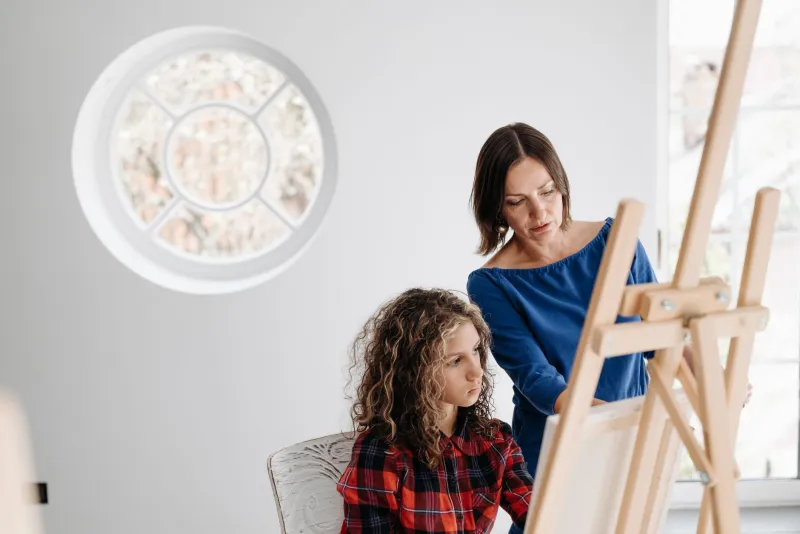
There's a moment in every young creative's life when the brochures arrive. Glossy pages full of studio spaces, graduate showcases, and tuition fees that could comfortably buy a terraced house in Ramsbottom. For a growing number of Bury's emerging artists, that moment now ends the same way — with the brochure going straight in the recycling.
They're choosing something different. Something older, in many ways. They're choosing to learn from someone who's already doing it, right here, in this town.
The Shift Nobody Saw Coming
It would be easy to frame this as a cost-of-living story, and yes, the economics matter. Student debt is real, graduate employment in the arts is patchy, and a three-year course in a distant city can feel like a gamble when the creative community you actually want to be part of already exists on your doorstep. But talk to the young people making this choice and you'll find something more principled going on than simple financial pragmatism.
"I visited two universities and they were both brilliant," says Priya, 20, who is currently apprenticed to a textile artist based near Bury Market. "But when I thought about what I actually wanted — to make things, to understand how a working practice functions, to know what it feels like to have a commission and a deadline and a real client — I realised the degree wasn't the fastest route to any of that."
She's been working alongside her mentor, a maker with over two decades of experience in sustainable fashion and installation work, for just under a year. Already, she's contributed to a public art commission, managed her own section of a community workshop, and sold three pieces through a local gallery. "I'm not saying university is wrong," she adds quickly. "I'm saying it wasn't right for me, right now."
What Mentors Get Out of It
The arrangement isn't purely altruistic from the mentor's side, and the good ones will tell you that openly. Marcus, a sculptor whose large-scale steel work has appeared in several Bury public spaces over the past decade, took on his first apprentice two years ago almost by accident — a teenager who kept showing up to ask questions at open studio events.
"I gave him a task to get rid of him, honestly," Marcus laughs. "He came back with something genuinely interesting. So I gave him another one."
What followed was an informal arrangement that has since become something both of them take seriously. Marcus's apprentice, now 19, handles fabrication prep, documents the making process for social media, and increasingly contributes ideas to early-stage design. In return, he gets access to tools, contacts, and the kind of contextual knowledge that no module can fully replicate.
"He asks me questions I haven't thought about in years," Marcus says. "Why do I do it this way? Why not that way? It's made me more reflective about my own practice. That's worth a lot."
The Gaps This Model Fills
It would be dishonest to pretend mentorship solves everything. Without formal accreditation, apprentices can struggle to prove their experience to funding bodies or arts organisations that still rely on degree-level qualifications as a shorthand for credibility. The relationships depend heavily on the quality and generosity of the mentor, and without structure, they can drift or collapse entirely.
Some of Bury's more established creatives are working to address this. A loose network of practitioners has begun meeting quarterly to share notes on how they're structuring their mentorship arrangements — what works, what doesn't, and how to give young people something more tangible at the end of the process than a handshake and a portfolio.
"We're not trying to replace universities," says one organiser of these informal gatherings. "We're trying to build a parallel pathway that's genuinely rigorous. One that's rooted in this place, this community, and the actual realities of making a living as an artist."
What Bury Offers That a Campus Can't
There's something specific about learning your craft in a town with Bury's particular creative texture. The festival culture, the market, the murals, the music venues — they're not backdrop. They're curriculum. An apprentice working here isn't studying art in the abstract; they're embedded in a living, breathing creative ecosystem with its own history, its own arguments, and its own very particular sense of what matters.
Priya puts it plainly. "My mentor knows everyone. She knows which venues are worth approaching, which funding pots are actually open to emerging makers, which collaborators she trusts. That network took her twenty years to build. I'm getting access to it at twenty. That's not something a lecture theatre can give you."
A Model Worth Watching
Across the UK, conversations about alternative routes into the arts are getting louder. As university costs rise and arts funding contracts, the question of how the next generation of creatives actually gets trained is becoming urgent. Bury isn't waiting for a national answer. It's quietly building one of its own — imperfect, evolving, and grounded in the belief that the best way to learn to make things is to be around people who already do.
The brochures will keep arriving. But more and more young artists in this town are finding that the most interesting education on offer isn't bound between glossy covers. It's happening in a studio down the road, with someone who'll hand you a tool and say: right then, show me what you've got.