Same Stage, Different Worlds: The Honest Conversation Between Bury's Old Guard and New Wave
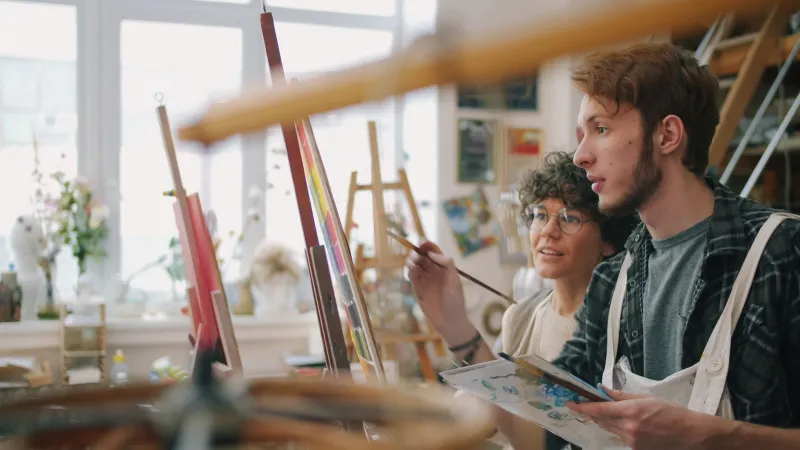
Let's not pretend there's no tension.
In arts communities across the UK, a quiet friction exists between generations of creatives — different assumptions about how art gets made, how it gets funded, what it's for, and who it's for. Bury is no exception. But what makes this town interesting is what happens when you push past the surface-level frustration and actually get people talking.
We spent time with artists at both ends of the generational spectrum — from veterans with decades of practice behind them to twenty-somethings who've grown up making work for screens before they ever set foot on a stage. What emerged wasn't a culture war. It was something closer to a collision of worldviews that, with a bit of patience, turned out to have more overlap than either side expected.
"We Had to Fight for Everything"
For Bury's established artists — those who came up through the 80s and 90s, navigating arts funding cuts, the collapse of manufacturing, and the slow grind of building creative careers in a town that didn't always take culture seriously — there's a deep-seated pride in what was built through sheer persistence.
"I spent years writing funding applications, knocking on doors, doing shows for thirty people in pubs," says one veteran theatre director who's been working in and around Bury for over two decades. "There's a certain amount of... I don't want to say resentment, but maybe bewilderment, when someone puts something on Instagram and it gets ten thousand views overnight and suddenly they're a professional artist."
It's a feeling that surfaces repeatedly in conversations with older creatives: a sense that the struggle was formative, that it built something essential, and that younger artists may be bypassing a process that actually matters.
But spend five minutes with those younger artists and a different picture emerges.
"We're Not Waiting for a Gatekeeping Institution to Validate Us"
Mia, 23, is a visual artist and digital content creator who grew up in Bury and has been building an audience online since she was seventeen. She's also, quietly, one of the more interesting artists working in the town right now — her work moves between large-scale printmaking and short-form video in ways that feel genuinely new.
"I think older creatives sometimes see the online stuff and assume it's shallow," she says, not unkindly. "But I'm using those platforms to fund the work that matters to me. The algorithm is basically my grant application. I just don't have to wait eighteen months for a decision."
This reframing — social media not as a distraction from real art-making but as a funding mechanism and distribution channel — is something many established artists genuinely hadn't considered. When it's explained in those terms, the reaction is often less dismissal and more curiosity.
Where the Real Clash Lives
If there's a genuine fault line, it tends to emerge around questions of craft and process rather than technology.
Several older creatives expressed concern — carefully, diplomatically — that the pressure to produce content constantly can undermine the kind of slow, iterative practice that produces genuinely mature work. "There's something about sitting with an idea for a year, letting it develop, that the internet doesn't really reward," reflects one sculptor who's been making work in the Greater Manchester area for three decades.
Younger artists, for their part, push back on what they see as a romanticisation of difficulty. "Why does struggle have to be the proof of seriousness?" asks Jordan, 26, a musician and producer who runs a small studio space in Bury town centre. "I can make something meaningful in an afternoon if the conditions are right. The old model of suffering for your art — I'm not interested in that."
What's interesting is that neither position is wrong. They're responses to genuinely different conditions.
The Unexpected Common Ground
Here's what surprised us most about these conversations: when the posturing drops, both generations want strikingly similar things.
They want space to make work — physical, affordable space that isn't constantly under threat. They want audiences who are genuinely engaged rather than passively consuming. They want the town to take its creative community seriously. And almost universally, they expressed a desire for more genuine intergenerational exchange — not mentorship in the traditional, hierarchical sense, but actual collaboration.
"I'd love to work with someone who's been doing this for thirty years and just... absorb some of that," admits Mia. "Not be told what to do. Just work alongside them."
That sentiment is echoed, perhaps surprisingly, from the other direction. "The young artists here are doing things I don't understand technically, and I find that genuinely exciting," says the theatre director. "I want to learn from them. I just don't always know how to ask."
Building Bridges at Bury Festival
Festivals like this one have a unique opportunity here. By deliberately programming work that pairs established and emerging artists — not as tokenism but as genuine creative exchange — there's a chance to model something the wider arts world often fails to do: treat generational difference as a resource rather than a problem.
The conversations we had suggest there's real appetite for this. The tension is real, but it's not insurmountable. It might even, handled well, be generative.
Bury's creative future probably doesn't belong to either generation alone. It belongs to what they build together — if they can manage to stay in the same room long enough to figure out how.