Loom to Life: The Makers Reviving Bury's Textile Soul
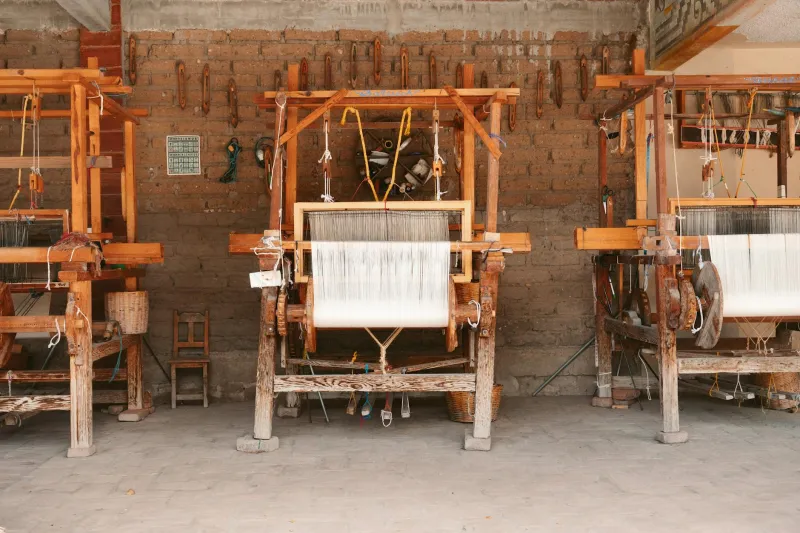
The Looms Are Singing Again
Walk through Bury's quieter streets today and you might catch something unexpected drifting from converted mill spaces and tucked-away studios – the rhythmic clatter of looms, the gentle hum of spinning wheels, the focused silence of hands working thread. After decades of industrial decline, the town's textile heritage isn't just surviving; it's thriving in ways its Victorian founders could never have imagined.
The transformation isn't happening in boardrooms or through council initiatives. It's bubbling up from grassroots makers, heritage enthusiasts, and creative rebels who've recognised something profound: Bury's textile DNA isn't just history – it's a living, breathing foundation for something entirely new.
From Heritage to Happening
Sarah Chen discovered her calling quite by accident. The former graphic designer stumbled across a Victorian hand loom in a Ramsbottom antique shop three years ago, and what started as curiosity quickly became obsession. "I brought it home thinking it would make an interesting coffee table," she laughs from her converted garage studio. "Six months later, I was teaching myself to weave and couldn't stop."
Today, Chen runs 'Thread Forward', a collective that pairs traditional weaving techniques with contemporary design sensibilities. Her tapestries – bold geometric patterns that echo both Bury's industrial past and its multicultural present – have caught the attention of Manchester galleries and London buyers alike.
"There's something about working with the same tools, the same motions that generations of Bury workers used," Chen explains. "You feel connected to something bigger than yourself. But we're not trying to recreate the past – we're using it as a springboard."
The New Mill Workers
Chen isn't alone in this textile renaissance. Across town, the Bury Makers Collective has transformed a former cotton warehouse into a buzzing hub of creative activity. Every Saturday, the space fills with spinners, dyers, seamstresses, and curious newcomers drawn by the promise of learning skills their great-grandparents might have taken for granted.
Collective founder Marcus Thompson, whose own family worked the mills for three generations, sees the movement as both homage and evolution. "My gran would spin stories about the camaraderie on the mill floor – women supporting each other, sharing techniques, creating something beautiful together. That spirit is exactly what we're recreating, just with different goals."
The collective's workshops have become legendary among Greater Manchester's crafting community. Their "Mill Floor Memories" sessions pair elderly former textile workers with young designers, creating an exchange of knowledge that benefits everyone involved. Recent collaborations have produced everything from haute couture pieces inspired by Victorian work uniforms to contemporary art installations using traditional dyeing techniques.
Threads of Innovation
What makes Bury's textile revival particularly exciting is its refusal to be bound by nostalgia. Local designer Priya Patel has built a following by creating garments that tell stories – literally. Her "Heritage Threads" collection incorporates patterns and techniques passed down through both her Indian heritage and her adopted Lancashire home.
"Bury taught me that textiles aren't just about fashion or decoration," Patel explains. "They're about community, identity, resilience. When I use traditional block printing alongside Lancashire weaving techniques, I'm creating something that couldn't exist anywhere else."
Patel's success has inspired others to explore similar cross-cultural textile dialogues. The town's diverse population – from long-established Pakistani and Bangladeshi communities to newer arrivals from across the globe – brings a wealth of textile traditions that are finding new expression in Bury's creative spaces.
The Community Loom
Beyond Individual Success
While individual makers like Chen and Patel grab headlines, the real revolution might be happening at community level. Local schools have begun incorporating textile heritage into their curricula, with students learning everything from basic weaving to the economic history that shaped their town.
The Bury Museum's "Hands-On Heritage" programme pairs these educational initiatives with practical skills training. Young people who might never have considered creative careers are discovering talents they didn't know they possessed, while older residents share knowledge that might otherwise be lost.
"We're not just preserving the past," notes programme coordinator James Walsh. "We're proving that traditional skills have contemporary relevance. These young people are learning patience, precision, problem-solving – skills that transfer to any career path."
Weaving the Future
As Bury's textile renaissance gains momentum, its impact extends far beyond individual studios and workshops. Local businesses are taking notice – boutique hotels are commissioning locally-made furnishings, restaurants are seeking custom table linens, and even tech companies are discovering the appeal of handcrafted office accessories.
The economic implications are promising, but the cultural impact might be even more significant. In an age of mass production and digital overwhelm, Bury's makers are offering something increasingly rare: the satisfaction of creating something beautiful, useful, and lasting with your own hands.
"Every thread tells a story," reflects Chen, watching a group of newcomers tackle their first weaving project. "We're not just making textiles – we're weaving a community, connecting past and future, creating something uniquely Bury."
As the looms sing their ancient songs in converted mills and garage studios across town, it's clear that Bury's textile heritage isn't just surviving – it's evolving into something the Victorian mill owners could never have imagined: a foundation for creativity, community, and hope.