Canvas of the Streets: Where Bury's Visual Rebels Paint Tomorrow's Stories
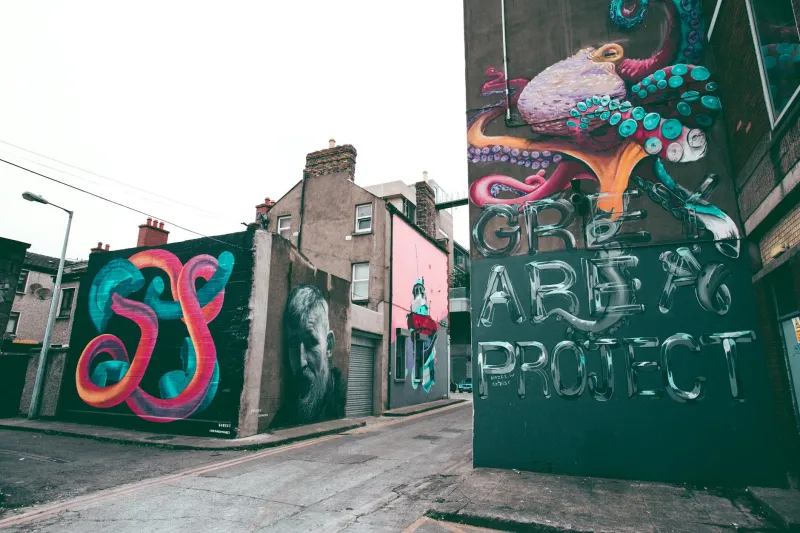
The Revolution Starts on Brick Walls
Walk down Silver Street at dawn, and you'll witness something magical: the town awakening to discover itself transformed overnight. What was once a tired row of shuttered shops now pulses with colour, as local muralist Jade Morrison puts the finishing touches on her latest piece—a swirling tapestry of mill workers morphing into modern-day artists, their tools evolving from spindles to spray cans.
"Bury's always been about making things," Morrison explains, wiping paint from her hands. "We're just continuing that tradition in a different medium."
This is the reality of Bury's visual arts renaissance: a grassroots movement that's turning every available surface into a canvas for storytelling. From the market's forgotten archways to the towering walls of defunct factories, artists are claiming space and rewriting the narrative of what this town can be.
Threading History Through Modern Eyes
In a converted mill space off Rochdale Road, textile artist Sarah Chen works with threads that tell stories spanning centuries. Her latest installation, "Woven Voices," incorporates fibres from the town's textile heritage—actual cotton threads salvaged from the old mills—woven together with contemporary materials sourced from local charity shops.
"Every thread has a history," Chen says, her fingers working through a complex pattern that resembles both industrial machinery and organic growth. "When someone donated their nan's old jumper to the charity shop, they probably didn't think it would end up in an art piece exploring intergenerational trauma and resilience."
Chen's work exemplifies how Bury's visual artists are refusing to let the town's working-class heritage become mere nostalgia. Instead, they're using it as raw material for contemporary commentary, creating pieces that honour the past whilst interrogating the present.
Gallery Spaces in Unexpected Places
Forget pristine white walls and champagne openings. Bury's most exciting gallery spaces are hiding in plain sight. The basement of Peel's Café has become an unofficial exhibition space where local photographer Marcus Williams displays his "Invisible Bury" series—intimate portraits of the town's overlooked residents shot in the very spaces they inhabit.
"Traditional galleries can feel intimidating," Williams observes. "But when you put art where people already are—in cafés, community centres, even bus stops—you're democratising the experience. Art becomes part of daily life rather than something you have to make a special trip to see."
This philosophy extends to the Bury Underground Collective, a loose network of artists who've claimed abandoned spaces throughout the town. Their latest project has transformed the derelict Millgate Shopping Centre into a temporary exhibition space, with installations that explore themes of economic decline and community resilience.
The Gentrification Tightrope
But this creative flowering doesn't exist in a vacuum. As property developers eye Bury's potential for regeneration, many artists find themselves walking a precarious line between celebrating their community and inadvertently pricing it out.
"It's the classic dilemma," admits street artist known only as "Loom," whose intricate stencil work adorns walls throughout the town centre. "We want to make Bury beautiful, to show its potential, but we're also aware that beauty can become a commodity that pushes out the very people who inspired it."
Loom's latest series addresses this tension directly, featuring images of demolished terraced houses sprouting expensive apartment blocks, with the caption "Progress for Whom?" stencilled beneath in fading letters.
Community Canvas Projects
Perhaps the most powerful response to these pressures has been the emergence of participatory art projects that embed the community directly into the creative process. The "Our Stories, Our Walls" initiative, coordinated by artist-activist Emma Rodriguez, has trained dozens of local residents to create their own murals.
"When the community creates the art, it's much harder to displace," Rodriguez explains. "These aren't decorations imposed from outside—they're expressions of the people who live here, created by the people who live here."
The results are visible throughout the town: a mural celebrating the Windrush generation on Tottington Road, created in collaboration with the local Caribbean community; a celebration of Bury's Pakistani heritage adorning the walls of the Islamic Centre; abstract patterns inspired by the town's Jewish history winding around the pillars of the market.
Digital Meets Physical
Innovation in Bury's visual arts scene isn't limited to traditional media. Digital artist Tom Bradley has been experimenting with augmented reality installations that overlay historical images onto contemporary spaces. Point your phone at the site of the old cotton mill, and you'll see ghostly images of workers from a century ago, their faces morphing into those of today's residents.
"Technology lets us layer time," Bradley explains. "Past and present can coexist in the same space, helping us understand how we got here and where we might go next."
The Future Canvas
As Bury continues to evolve, its visual artists remain committed to ensuring that evolution includes everyone. New initiatives are emerging monthly: pop-up galleries in empty shops, collaborative murals bringing together artists from different cultural backgrounds, and workshops teaching traditional crafts alongside contemporary techniques.
The message is clear: this town's story is still being written, and everyone gets to hold the brush. In Bury, art isn't something that happens to a place—it's something that emerges from it, as natural and necessary as breathing.
Walk these streets with open eyes, and you'll see a town that refuses to be defined by what it once was, choosing instead to paint its own future, one wall at a time.